From the Water: How to Photograph the Kaunos Rock Tombs
The photograph of the tombs is decided at the quay, not on the deck, and mostly by the weather.
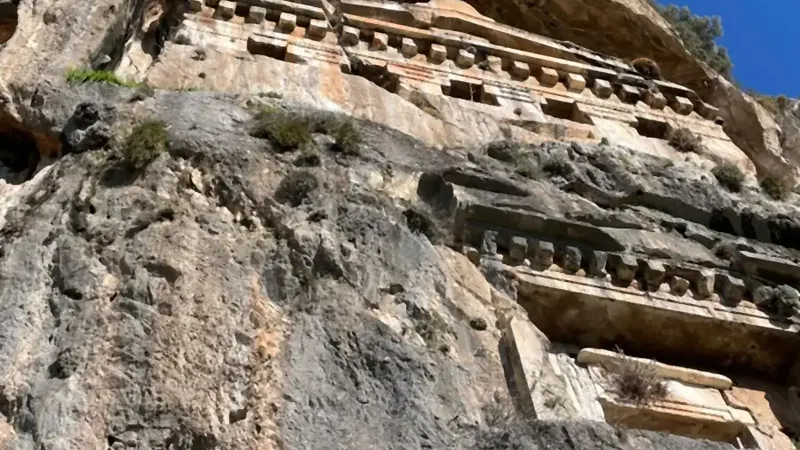
Nearly everyone leaves Dalyan with a photograph of the rock tombs, and nearly all of those photographs are the same photograph: a pale cliff, a great deal of empty river, and something clearly important sitting too far away to make out. The camera is rarely the reason.
What settles the picture is which boat you are standing on, what the surface of the river is doing that morning, and whether you had decided what you were after before the engine dropped to idle. All three are fixed before you leave the quay, which is why this reads more like a planning note than a photography lesson.
Decide which of the three photographs you want
There is no single picture of the Kaunos tombs. There are three of them, they want different distances, different lenses and different hours, and trying to collect all three in one pass is why most people come home with none.
The first is the carving itself: columns, architrave and pediment filling the frame. It wants length, closeness and light arriving across the face rather than down onto it. The second is the cliff in its landscape, with the water, the reed line and something for scale, which wants very nearly the opposite. The third is the town picture, taken from the eastern bank looking across at the whole cliff standing over the moored boats.
If we are honest, the first is the one everybody chases and the one that disappoints most reliably. A tight frame of one facade taken across several hundred metres of moving water is a technical exercise, and when it comes off it looks like a photograph of a wall. It is the other two that end up framed at home.
The river decides more than the clock does
Everybody asks about the hour. The hour matters, and the middle of the day is no use to anyone, but on this stretch of water the state of the surface changes the result more than the angle of the sun does.
| What the water is doing | What it does to the picture | The sensible response |
|---|---|---|
| Glass flat, first thing | The whole cliff repeats itself upside down below the reed line | Frame low and leave room underneath for the second cliff |
| A light breeze | The reflection breaks into colour with no shape left in it | Give up on the mirror and photograph the rock |
| Wash from a boat that has already gone | Reaches you late and rocks the deck for half a minute | Wait. It passes sooner than you can correct for it |
| Soft air in July and August | Distance goes milky and a long lens stops resolving anything | Work wide and near rather than long, because no edit puts it back |
| The morning after rain | Clean air, darker stone and colour in everything | The best it gets here, and the least possible to plan for |
None of this can be booked in advance. If the photograph is the point of the day, keep the day loose and ask at the quay on the morning rather than committing three days ahead.
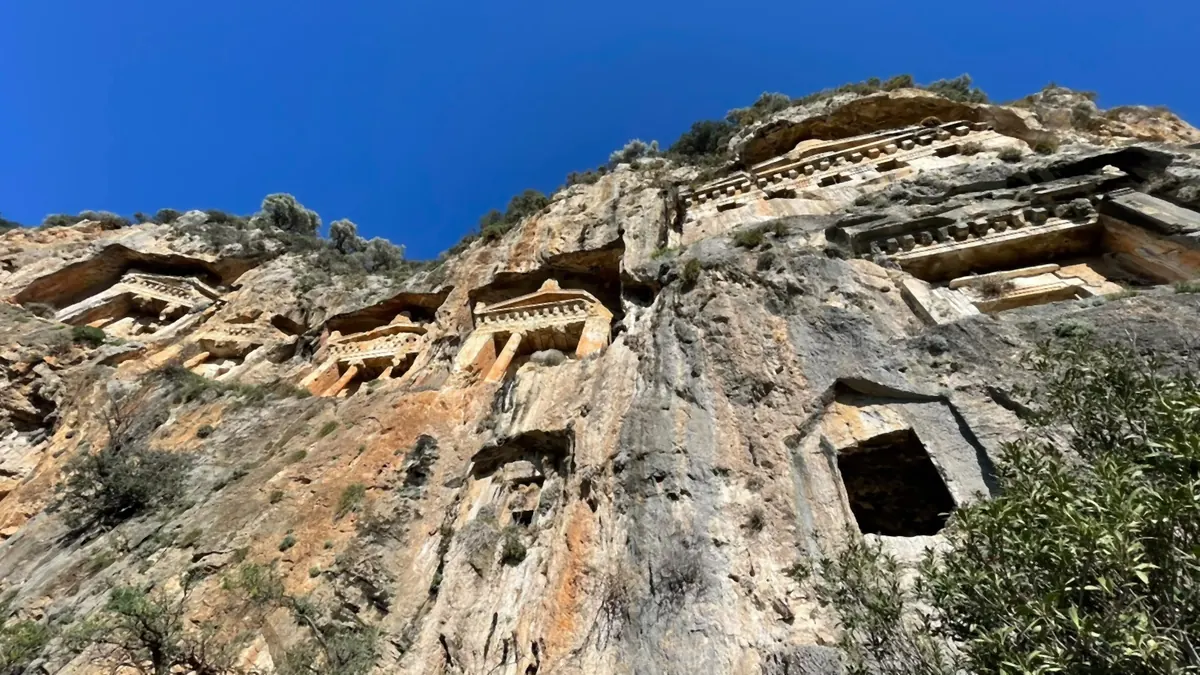
A cliff on its own has no size
The commonest failure here is neither exposure nor focus. It is that a bare rock face gives the eye nothing to measure against, so a cliff of thirty metres and a garden wall photograph identically.
The delta hands you the answer free of charge. Reed tops make a foreground, another boat crossing the frame gives the height a number, and a shoulder from your own deck in the corner does more for the scale than any amount of care taken over the rock.
- Reeds along the bottom of the frame, which also covers the flat water you did not want in it.
- A passing boat, ideally small and ideally not in the centre.
- Somebody on your own deck, close and out of focus, at the edge.
- The ridge behind the tombs, which most people crop away and which is what makes the cliff read as part of a mountain.
- The town bank in the same frame, if you are far enough downstream to hold both.
You are standing on something that moves
A boat at idle is never still. It swings on the current, it settles when the engine cuts and it lifts again the moment somebody walks across to the other rail. None of that is a problem if you expect it, and all of it is a problem if you are trying to hold a long lens as though there were a floor underneath you.
The answer is speed and repetition rather than care. Take three or four frames each time instead of one considered one, keep your elbows in against your ribs rather than out on the rail, and let your knees absorb what the hull is doing.
- Stay seated if you can see from there. Standing up on a shared deck moves the boat and blocks the eight people behind you.
- Bursts, not single frames. One of four will be sharp and the screen will not tell you which.
- Nothing on a tripod. There is no floor here to stand it on.
- Wipe the lens before the cliff rather than after it. Everything that lives on a boat ends up on glass.
- Charge whatever you are shooting with. Heat and a bright screen flatten a phone quicker than a day out ought to.
What we would not bother photographing
Some of what people point cameras at on this river does not repay the effort, and saying so plainly is more use than another list of settings.
- The tombs at midday from directly beneath. You are looking almost vertically upward, the fronts squash into slots and the light comes from the least helpful place available.
- The floodlit tombs from a moving deck. Beautiful to sit and look at, and the exposure is far too long for anything that floats.
- The whole cliff with the whole sky above it. There is nothing in the top half of that frame and there never was.
- Anything shot through the wheelhouse glass.
- Video of the pass, unless you have a particular reason. Nobody watches forty seconds of a cliff going by, including the person who filmed it.
The bank you are allowed to stand on
The most underrated position in Dalyan is the promenade on the town side. It is solid, it costs nothing, you can return to it every evening of the week, and it is the only place from which you can wait for the light rather than arriving at whatever hour the boat happens to pass.
It also gives you a foreground that cannot be bought from the water: moored boats, a wooden jetty, an awning, a table with somebody's breakfast still on it. A picture of a cliff turns into a picture of a place the moment there is a town along the bottom of it.
The lit tombs belong here too. After dark, in season, they are floodlit from below, and that exposure is entirely manageable with a camera set down on a wall or a railing. On a deck it is not. Whether they are lit on any given night is not ours to arrange, so treat it as likely rather than promised.
The part no photograph carries
You cannot land at the tombs and you cannot climb to them. The ledge is closed off and the rock below it is unstable, so the water and the far bank are as close as anybody gets, and whatever you take from those two places is the whole of the access.
What no frame has ever held is the quiet. The engine drops, the deck goes silent without anyone suggesting it, and for a couple of minutes the loudest thing on the river is water moving along the hull. That is most of what people actually remember about the pass.
Which is our case for putting the camera down on the second run past. You will have the picture by then, and the alternative is spending a river day looking at a screen, which strikes us as a poor exchange for water you travelled a long way to sit on.
If the picture is the reason for the day
Almost all of the above comes back to one thing: the hour at which you are in front of the cliff. On a shared day boat that hour is set by the mud pool, by lunch and by the beach, and the tombs get whatever the schedule has left over.
Two arrangements hand it back. An evening run down into the delta puts you there for the last of the light and then again on the way home. A boat taken for your own party lets you name the hour outright, which for anyone carrying a camera is the one thing on this river worth arranging in advance. Send us the date and we will tell you which is free.
Frequently asked questions
Can we ask the skipper to stop for a photograph?
On a private boat, yes, and it is one of the better reasons to take one. On a shared boat he slows under the cliff for a few minutes because the route says so, and that is the whole of what is on offer. Nobody holds thirty people for one frame.
Is a phone good enough?
For the cliff in its landscape, easily. For the carving across that much water, no. Use the longest lens your phone genuinely has and stop at that point, because beyond it the phone is supplying detail it never collected.
Sunset cruise or day trip, for photographs?
The evening run, without much hesitation. It reaches the cliff when the light is crossing it rather than falling onto it, and it comes back past the tombs after dark. The day trip is the better day out and the worse photograph.
Are the tombs lit at night?
In season, usually. The lighting is not ours, so we mention it rather than promise it. Photograph it from the town side with the camera resting on something solid, because a boat after dark is not a platform for that exposure.
Is it worth going past them twice?
If the conditions changed, yes. Two passes in the same weather give you the same picture twice over. A morning boat and an evening one in the same week give you two different pictures.
You may also want to read
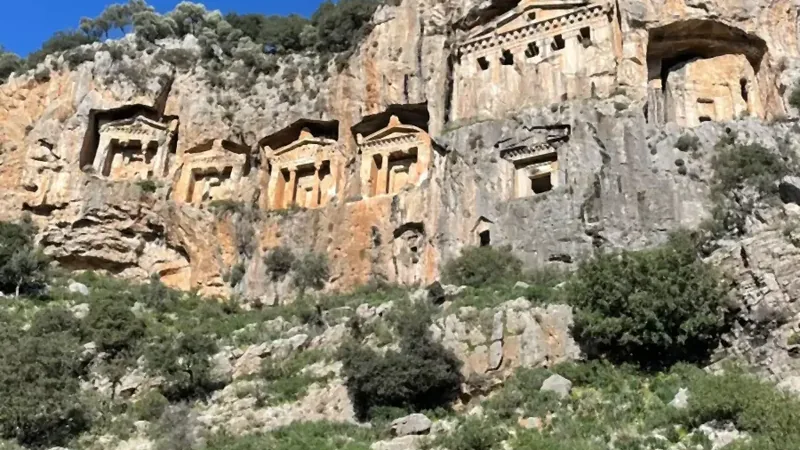
Kaunos and the Rock Tombs
Temple fronts cut into a cliff, and a harbour city the river silted up and stranded.
Read more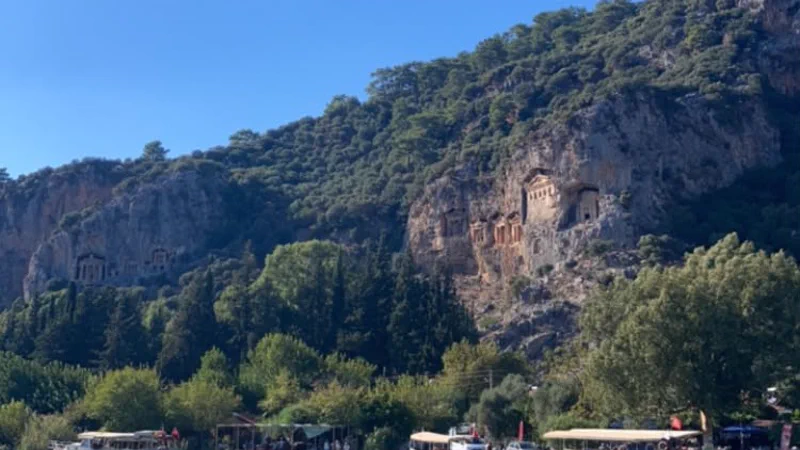
Dalyan Sunset Cruise
Two hours on flat water while the light goes, and the tombs lit from below on the way home.
Trip details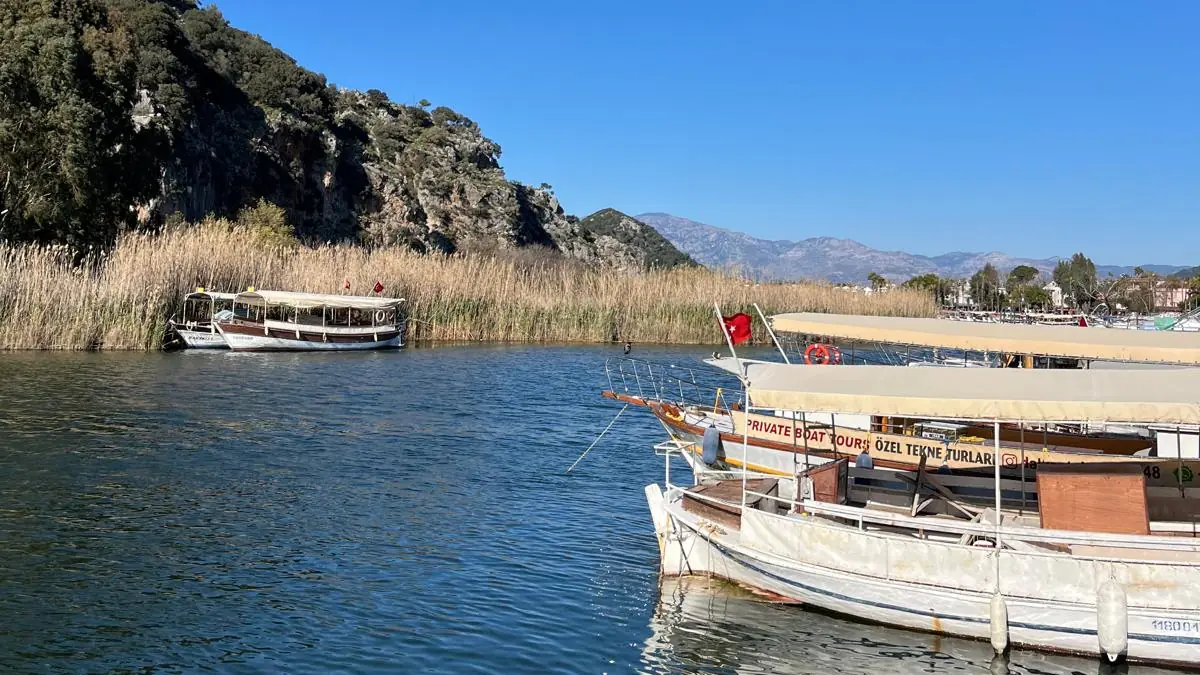
Private Boat Charter From Dalyan
The same river with the timetable removed. You set the stops and the hour you turn back.
Trip details
When to Go
The months nobody argues about, and the ones worth arguing about.
Read more