The Kaunos Rock Tombs at Night: Where to Stand and What You Will See
Four places to stand, one reason the reflection fails, and what the lighting actually shows.
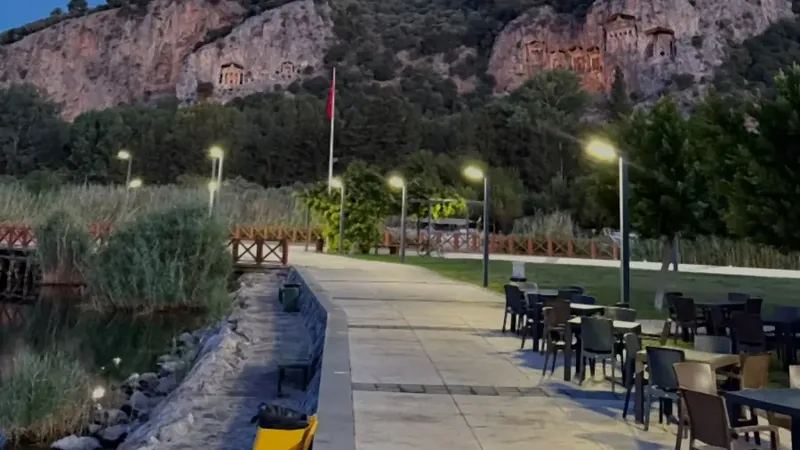
The rock tombs cut into the cliff opposite Dalyan are the reason most people recognise the town in a photograph. In daylight they are impressive. After dark, when the floodlights come on and the river goes still, they become something else entirely: a row of lit doorways hanging in a black hillside, with a second row upside down in the water.
This is the rare sight that asks nothing of you. No ticket, no boat, no early start. You walk to the riverbank and look up. What follows is where to stand, what the light shows that daylight hides, and why some nights give you the reflection and some do not.
What you are looking at
These are the tombs of ancient Kaunos, carved into the rock face in the fourth century BC. They are temple fronts rather than buildings: columns, pediments and doorways cut directly into the cliff, leading to chambers behind.
They are often called Lycian tombs, and the style is shared with Lycia next door, but Kaunos was a Carian city on the border between the two. The tombs belonged to its wealthy dead, placed high on the rock so the city and the river below could see them.
Look at the row carefully and you will find one that was never finished. The outline is roughed out and the columns are missing. Twenty-four centuries later the work simply stopped, and the floodlights show that unfinished shape as clearly as the finished ones.
When the lights come on
The lighting switches on once it is properly dark rather than at sunset, so there is a gap of roughly half an hour between the last colour in the sky and the first orange on the cliff. That gap is worth waiting through: the best frames come in the few minutes when there is still deep blue above the rock and the floodlights are already burning.
The lighting is warm and directional. It picks out the column shafts and the door recesses, and it leaves the rest of the cliff dark, which is why the tombs read as separate objects at night and as part of a grey wall by day.
It is a permanent installation, not an event, and it runs through the evening on ordinary nights in season. Like any outdoor lighting it is occasionally off for maintenance.
The four places to stand
All four are within a fifteen-minute walk of each other. If you have one evening, walk between them rather than choosing in advance; the river changes the answer from night to night.
- The main promenade opposite the cliff. The default view, wide and unobstructed, with the moored boats in the foreground.
- The wooden decks by the reed beds, at the quiet end of the walkway. The closest thing to a clean foreground: reeds, water, cliff, nothing else.
- A riverside restaurant terrace. Slightly raised, which lifts the tombs above the boat masts. You are paying for dinner, not the view, but the view comes with it.
- The boat quay itself. The tombs sit further off to one side here, but you get the lit boats and the town lights in the same frame.
Why the reflection appears on some nights and not others
The upside-down cliff in the water is the picture people remember, and it is entirely a question of the river surface. Three things break it.
Wind is the usual culprit. Even a light afternoon breeze that has not dropped by nine will roughen the surface enough to smear the reflection into a glow. The river is usually calmest in the hour before midnight and again before dawn.
Boat movement is the second. A single tender crossing puts a wake across the whole width of the river, and it takes a minute or two to settle. If the reflection breaks up, wait rather than move.
The third is rain on the surface, which is obvious, and the one no one expects: a full moon. Strong moonlight lifts the brightness of the whole hillside and reduces the contrast that makes the lit tombs stand out.
Getting a usable photograph
- Brace the phone on the railing or a wall. This is the single biggest improvement available and it costs nothing.
- Use night mode and let it run the full exposure. Hold still until the counter finishes.
- Turn the flash off. It lights the railing and does nothing to a cliff two hundred metres away.
- Tap the tombs to set the exposure, then drag the brightness down a little. Phones overexpose warm light against black.
- Include the reeds or the boats in the frame. A lit cliff alone has no scale.
- If you carry a camera, a small tripod and a two-second timer turn this into an easy shot rather than a lucky one.
Can you see them from a boat at night?
Sunset cruises turn back as the light goes, so they give you the tombs in the last of the daylight rather than under the floodlights. That is a different photograph, and for many people a better one.
The floodlit version is really a view from the bank. From the water you lose the still reflection, because your own boat is the thing breaking it.
If you want both in one evening, take a sunset trip and then walk the promenade after dinner. The tombs will be lit by the time you are back on land.
What you cannot do after dark
You cannot reach the tombs themselves. They are part of the protected Kaunos archaeological site, they are not open to visitors at any hour, and the chambers have been closed for a very long time.
The ancient city of Kaunos, the theatre and the acropolis are a separate visit on the far bank, reached by rowing boat during the day and open in daylight hours with a ticket. None of that runs at night.
So the night version of this sight is a looking experience from the town side, and that is the whole of it. The good news is that it is the best angle anyway.
See them twice
The daytime view from the river shows you the scale: how high the tombs sit, how thin the ledge below them is, how much rock had to be removed by hand. The night view shows you the shapes: the columns, the pediments, the dark doorways.
They are not the same sight, and most visitors only get one of them because the tour ends at five and dinner is somewhere else. Walking back to the bank at nine costs nothing and completes the picture.
Frequently asked questions
Are the Kaunos rock tombs illuminated every night?
They are lit on ordinary evenings through the season, switching on after full dark rather than at sunset. Like any outdoor installation the lighting is occasionally off.
Do you have to pay to see the tombs lit up?
No. The floodlit view is from the public riverbank in Dalyan and costs nothing. A ticket is only needed for the Kaunos archaeological site on the far bank, which is a daytime visit.
Can you go inside the rock tombs?
No. The tombs are protected and cannot be entered or approached; they are seen from a distance only, from the town side or from the river.
What is the best spot to photograph the tombs at night?
The wooden decks by the reed beds give the cleanest foreground, and a riverside restaurant terrace lifts the tombs above the boat masts. Brace the phone on a railing wherever you stand.
Are the tombs Lycian or Carian?
Kaunos was a Carian city, so the tombs are Carian, though the temple-front style is shared with neighbouring Lycia and the name Lycian tombs has stuck locally.
You may also want to read
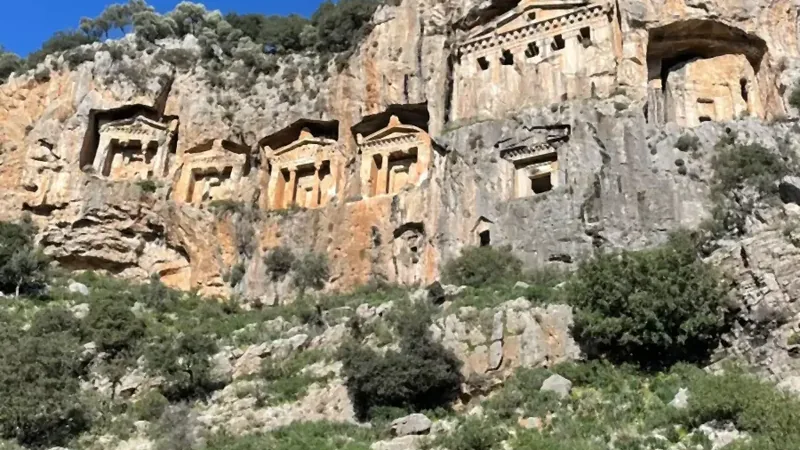
Kaunos and the Rock Tombs
Temple fronts cut into a cliff, and a harbour city the river silted up and stranded.
Read more
From the Water: How to Photograph the Kaunos Rock Tombs
The photograph of the tombs is decided at the quay, not on the deck, and mostly by the weather.
Read more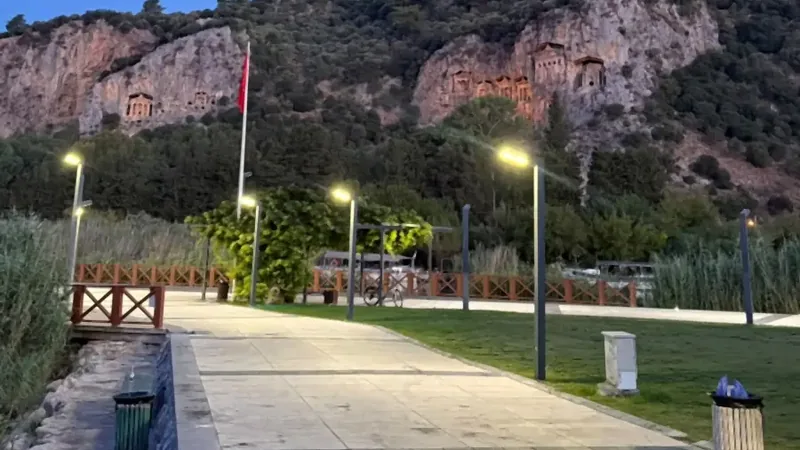
Dalyan After Dark: What the Riverfront Is Like at Night
The town changes at nine in the evening. Here is what is still open, what gets lit, and how to walk it.
Read more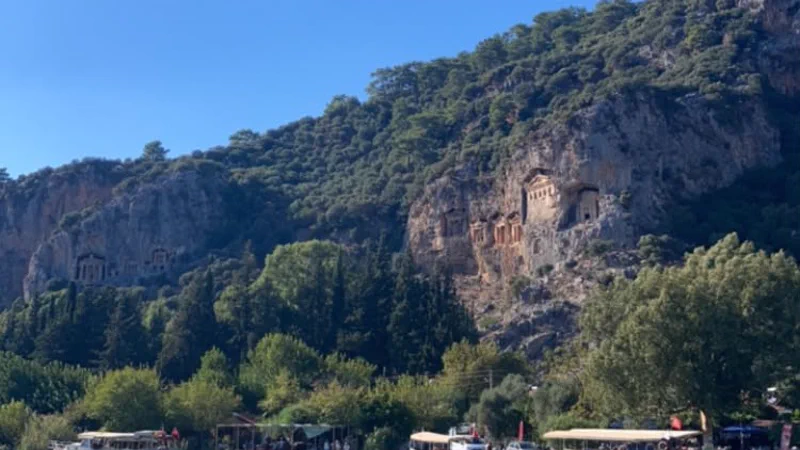
Dalyan Sunset Cruise
Two hours on flat water while the light goes, and the tombs lit from below on the way home.
Trip details
Dalyan Day Boat Trip
The whole river in one day: tombs, sulphur pools and the long stop at Turtle Beach.
Trip details