The Kaunos Rock Tombs Up Close: How They Were Cut and Who They Were For
From the river they are a skyline. From the path below they are a building site that stopped mid-job.
Seen from a boat the rock tombs read as a row of little temples in the cliff. Walk up the path on the far bank and the illusion breaks in a useful way: they stop being scenery and become stonework, with tool marks, mistakes and one tomb that was simply abandoned.
This page is about what you are looking at. Not the view, the object: who cut it, how, in what order, and why it looks like a temple when it is a grave.
Temple fronts, not temples
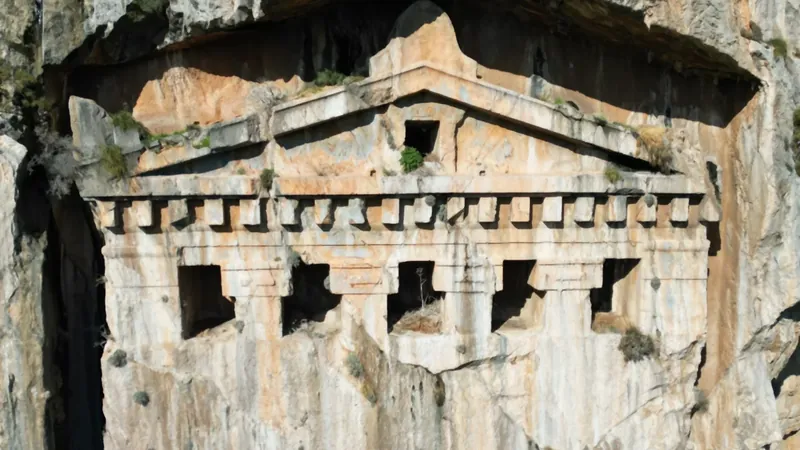
Each of the large tombs is a temple façade carved directly into the living rock: two or four columns, a frieze of square blocks above them, and a triangular pediment on top. Behind the columns there is no building at all, only a door into a chamber.
The style copies the Ionic temples of the Greek world, which is the point. A Carian family that could afford this was saying something about its place in a Greek-speaking Mediterranean.
They are usually dated to the fourth century BC, the same era that gave Kaunos its theatre. The city itself is far older; the tombs belong to its wealthy, late-classical phase.
Carian, not Lycian
The local name for them is Lycian rock tombs, and the guidebooks have mostly followed. Kaunos was a Carian city, on the border with Lycia, and the temple-front type is shared across that border.
The label is not exactly wrong, but it is loose. If you want the accurate sentence: these are Carian tombs in a style also used in Lycia.
The distinction matters once you have seen Lycian sarcophagi elsewhere on this coast. Those are free-standing stone boxes on legs. These are architecture, cut into a wall.
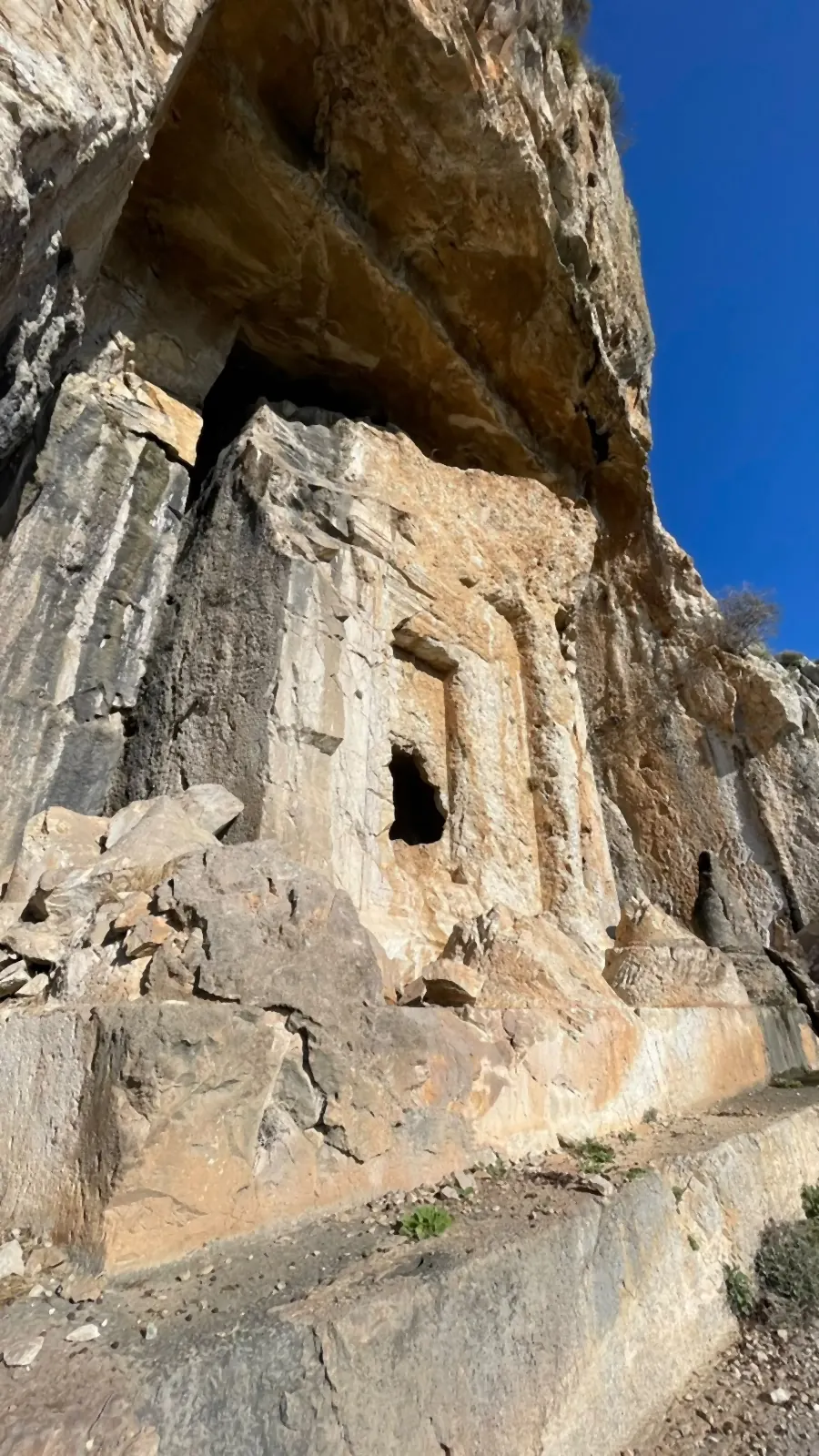
The unfinished tomb, and what it teaches
Below and to one side of the largest tomb there is one that was never completed. The outline is roughed out, the doorway is cut, and the columns were never carved. It sits there, half-made, in full view.
That single unfinished face explains the whole method. The masons started at the top, cut a working ledge, carved the pediment and frieze first, and worked downward. There is no scaffolding problem that way: the rock you are standing on is the rock you have not cut yet.
It also explains why the finished tombs look so crisp. Everything above was finished before anything below was touched, so there was never a need to reach up over completed work.
What is behind the door
Behind the façade is a plain rectangular chamber, usually with stone benches cut along the sides. These are family tombs, meant to be reopened and used again.
There is no decoration inside worth the climb, and in any case nobody climbs: the chambers are closed to visitors and have been for a long time. The ones you can peer into from the path are the small, plain niche graves lower in the rock.
Everything portable was taken long ago. Tomb robbing here is not a modern story; most of these chambers were emptied in antiquity.
The smaller graves nobody photographs
The cliff is a graded cemetery, not a monument. The famous row is the expensive top line of it, and the rock around and below is full of ordinary burials.
- Simple rectangular niches cut into the rock at head height, with no façade at all.
- House-type tombs with a plain pitched roof instead of a pediment.
- Rough-cut openings that look unfinished because they are: the cheap end of the same cemetery.
- A few chambers with the door frame carved but the interior barely hollowed out.
How close can you actually get
Close enough to see the tool marks, and no closer. The path through the Kaunos site runs under the cliff and gives you a steep view straight up at the façades, which is the best angle there is for the carving itself.
You cannot reach the tombs, enter them, or climb to the ledge. They are protected, the rock is loose, and the drop is real.
From the river you get the composition; from the path you get the detail. Anyone who cares about the stonework should do both, and the walk is the half that most visitors skip.
Photographing them from below
- Go in the morning. The cliff faces roughly east and the façades are lit early; by afternoon they are flat and grey.
- Shoot from the path rather than stepping off it. The extra two metres buy nothing and the ground is loose.
- Include a tree or a person for scale. Without one the frieze reads as a model, not a building.
- A zoom or a phone telephoto earns its keep here more than anywhere else in Dalyan.
- Look for the unfinished tomb before the finished ones. It is the picture nobody else comes home with.
Why they are still there
Because they are part of the rock. A free-standing monument of this age on a coast this busy would have been quarried for building stone centuries ago; a façade cut into a cliff is not worth the trouble to remove.
The same logic protects them now. There is nothing to steal and nowhere to walk, so the main job of the site is keeping people off the loose ground below rather than guarding the tombs themselves.
It is the reason a two-and-a-half-thousand-year-old row of grave fronts is the first thing you see from a town quay, and the reason it will still be there when you come back.
Frequently asked questions
How old are the Kaunos rock tombs?
The large temple-front tombs are generally dated to the fourth century BC. The city of Kaunos itself is much older, with settlement traces going back many centuries earlier.
Are the Kaunos tombs Lycian or Carian?
Kaunos was a Carian city, so the tombs are Carian. The temple-front style is shared with neighbouring Lycia, which is why the name Lycian rock tombs stuck locally.
Why is one of the tombs unfinished?
One façade was roughed out and abandoned before the columns were carved. It shows the method clearly: the masons worked from the top down, finishing each level before cutting the one below.
Can you go inside the rock tombs at Dalyan?
No. The chambers are closed and cannot be reached or entered. They are seen from the path below the cliff or from the river.
What is inside a Kaunos rock tomb?
A plain rectangular chamber with stone benches along the sides, used for several burials by one family. The contents were removed in antiquity.
You may also want to read
Visiting Kaunos: the Ancient City Behind the Rock Tombs
Everyone photographs the tombs from the river. Far fewer cross over and walk up to the city they belong to.
Read more
The History of Kaunos: a Port City the Sea Walked Away From
The city did not fall to an army. It was buried, slowly, by its own river.
Read more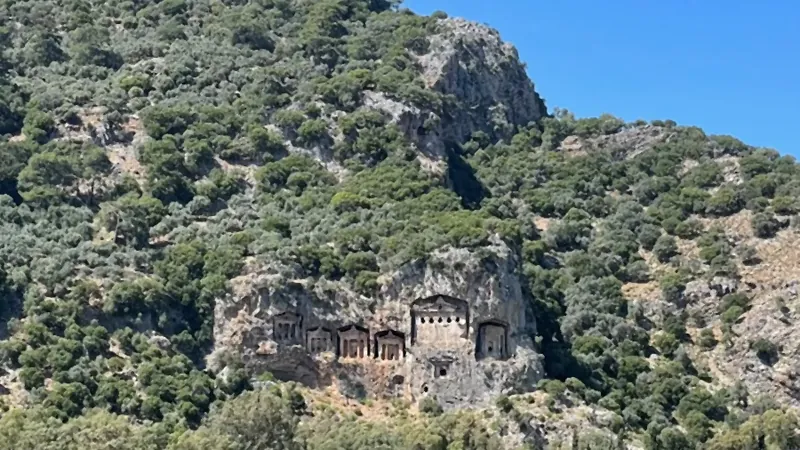
Seeing the Rock Tombs from the River: Where to Sit and When to Go
The famous view lasts about four minutes. Here is how to not spend them looking the wrong way.
Read more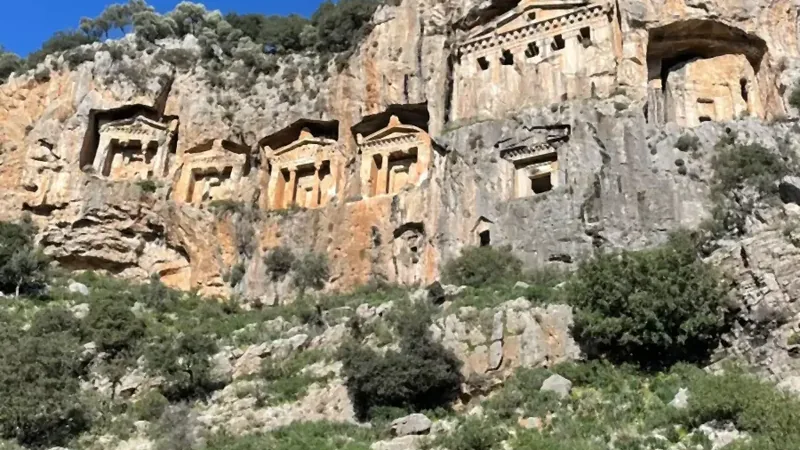
Kaunos and the Rock Tombs
Temple fronts cut into a cliff, and a harbour city the river silted up and stranded.
Read more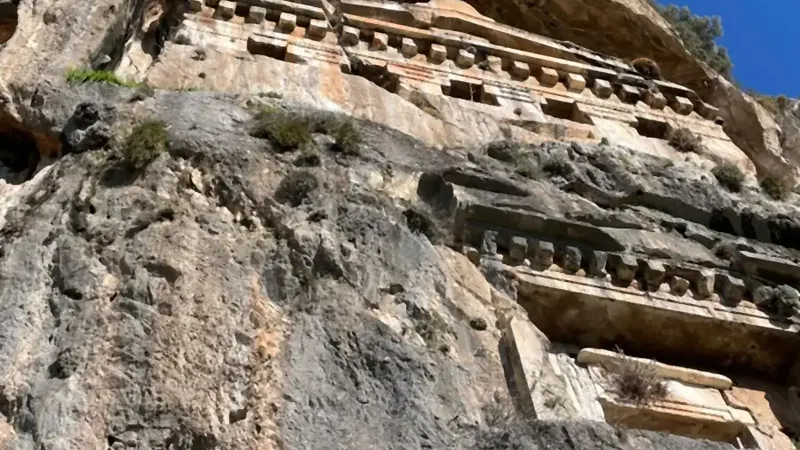
From the Water: How to Photograph the Kaunos Rock Tombs
The photograph of the tombs is decided at the quay, not on the deck, and mostly by the weather.
Read more